Collect Udhaar Before Diwali Without Losing Customers
The weeks before Diwali are the one time of year when asking for old dues feels normal, not rude. Here is how to use that window well.
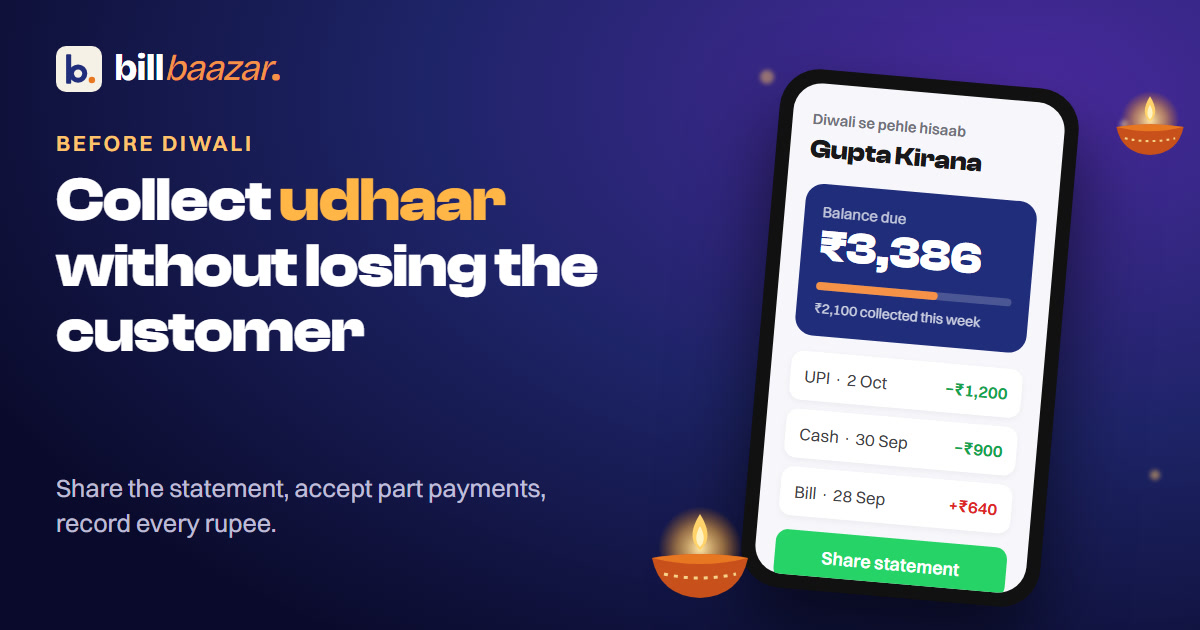
Every shop owner knows the feeling. A regular customer walks in, picks up their usual things, says "khate mein likh dena," and walks out. You know their balance has been creeping up since the summer, and you know you should collect udhaar before Diwali. You also know that if you bring it up the wrong way, they might start buying from the shop down the road.
So you say nothing. And the balance keeps growing.
If there is one time of year to break that pattern, it is now. The weeks before Diwali are when it is normal — even expected — to collect udhaar and settle old accounts before the new year. This guide is about how to do that well: collect the money, and keep the customer.
Why you should collect udhaar before Diwali
In most of India, and especially among trading families, the new financial year in the traditional sense begins after Diwali. Books are closed, new ones are opened at Chopda Pujan, and people prefer to start the new year without old debts hanging over them. Customers feel this too.
That means for once, you are not the one bringing up an awkward topic. The season brings it up for you. "Diwali se pehle hisaab saaf kar lete hain" is a sentence nobody takes offence to.
There is a second, more practical reason. The festive season is when you need cash most. You are buying extra stock, paying suppliers, maybe paying staff a bonus. Money sitting in customers' khatas is money you cannot use for any of that.
Step 1: Know your real numbers first
Before you speak to a single customer, you need to know exactly who owes what. This sounds obvious, but it is where most collection efforts fall apart.
If your khata is on paper, sit down one evening and total every open account. Make a simple list: name, amount, and how long it has been pending. Then sort it by amount.
You will usually find something surprising. A handful of customers — often fewer than ten — account for most of the money. That is where your effort should go first.
If your khata is digital, this step takes seconds rather than an evening: the list of who owes you, sorted by amount, already exists.
Step 2: Check before you ask
Nothing damages a relationship faster than asking a customer for money they have already paid. Before approaching anyone, check their account carefully. Was there a payment you forgot to note? A return that was never adjusted?
This matters because the whole conversation rests on the number being right. If the customer can point to one mistake, they will doubt everything else — and you will spend the conversation defending your book instead of collecting.
We wrote in detail about managing customer udhaar without losing money; most of it comes down to exactly this — a number both sides believe.
Step 3: Start with a statement, not a request
The softest way to collect udhaar is not to ask for money at all. It is to share the account.
"Bhaiya, Diwali aa rahi hai, aapka hisaab bhej raha hoon — ek baar dekh lijiye."
That is it. You are not demanding anything. You are giving them the information, respectfully, and letting them act on it. Most customers who are able to pay will pay, because the number is in front of them and the season makes it natural.
This works far better when the statement is clear and itemised — dates, what was bought, what was paid. A single number written on a scrap of paper invites questions. A full list of entries answers them before they are asked.
Step 4: Make it easy to pay today
A surprising amount of udhaar stays unpaid simply because paying takes effort. The customer means to pay, gets busy, and forgets.
Remove every bit of friction:
- Accept UPI at the counter and keep your QR code visible. Most customers have it on their phone; few carry large cash.
- Accept part payments happily. ₹2,000 today is better than ₹5,000 "next week" that never comes. Record it immediately so the customer sees their balance drop.
- Offer a date, not an open promise. "Dhanteras tak ho jayega?" gives both of you something concrete.
Step 5: Handle the difficult ones with respect
Some customers genuinely cannot pay right now. The festive season is expensive for them too.
For these customers, a smaller, agreed amount before Diwali, with the rest planned after, keeps both the relationship and the account alive. Write down what you agreed, the same day.
For the rare customer who keeps avoiding the conversation, it is fair to stop extending new credit until the old balance comes down. You do not need to announce it or make it a confrontation. "Pehle purana wala thoda kam kar dijiye, phir naya chalu karte hain" says everything politely.
Step 6: Record every payment the moment it happens
This is where many collection efforts undo themselves. You collect ₹3,000 during the Dhanteras rush, mean to note it later, and forget. In January the customer's balance still shows the old amount, and now you are the one who made the mistake.
Record every payment at the counter, while the customer is still standing there. If they can watch their balance go down, the trust you built by collecting politely stays intact.
Start the new year with a clean khata
The goal of collecting udhaar before Diwali is not just the money. It is to begin the new year with accounts you and your customers both trust. That is the whole spirit of Chopda Pujan — a fresh book, with true numbers.
The best time to make that fresh start permanent is right after Diwali. When every credit sale and every payment is recorded as it happens, next year's collection does not need a six-step guide. Every customer's balance is always correct, always itemised, and always ready to share.
If you want to see how that works on a phone, here is BillBaazar's digital khata. It is free for 15 days — no card needed — so you can try it through the festive season and decide after.
Try BillBaazar in your shop
Free for 15 days, no card needed. We'll move your customer list across for you.
Keep reading
Ready to close the notebook?
Set up your shop in ten minutes. Free for 15 days, no card, and we'll move your customer list across for you.