Chopda Pujan 2026: Start Your New Bahi-Khata Digitally
The puja stays exactly as it is. What changes is where the next 365 days of entries live — and whether you spend Diwali week recopying balances by hand.
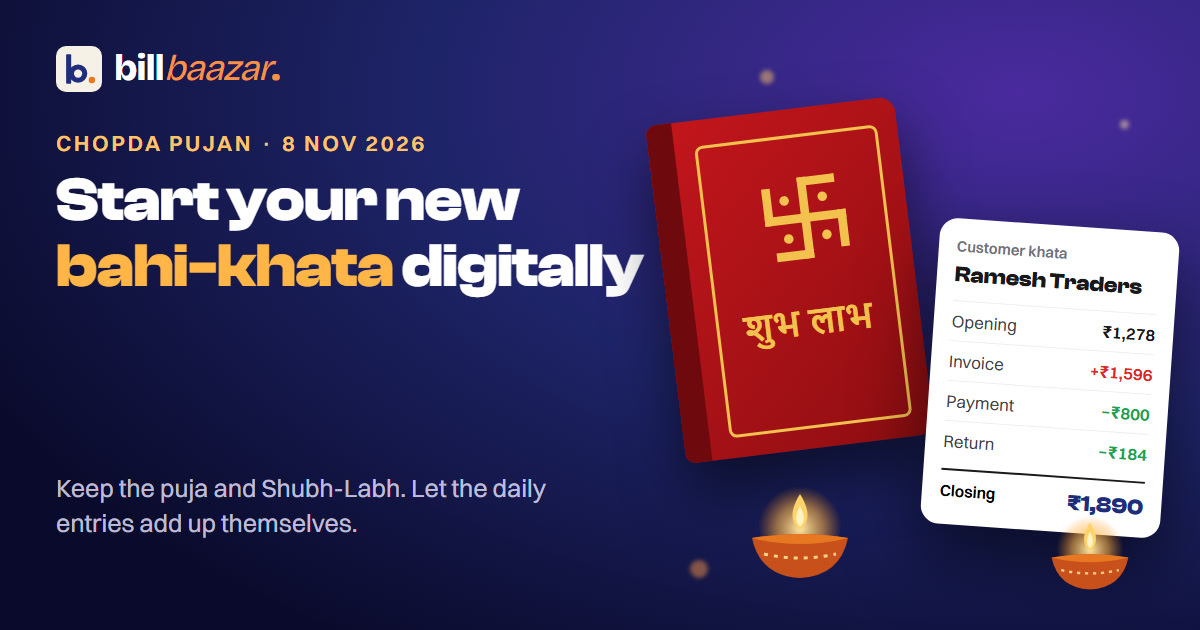
On Sunday, 8 November 2026, shops across Gujarat and beyond will close their doors a little early, lay out a fresh red bahi-khata, and do Chopda Pujan. The next morning is Bestu Varas, and Vikram Samvat 2083 begins. It is one of the few days in the year when a trader stops and looks at the whole year at once.
This post is not about replacing any of that. The puja, the swastika, the "Shubh-Labh" on the first page, the first auspicious entry — those belong to the day, and they should stay. It is about the other 364 days, and the work that quietly happens in the week before Diwali.
What Chopda Pujan actually marks
Chopda Pujan (also called Sharda Pujan) is the worship of the account books. Traditionally, the old year's accounts are closed, and a new chopdo is opened for the new year, its first page marked with a swastika, Shubh-Labh, and an invocation to Ganesha and Lakshmi.
Underneath the ritual is a very practical idea: start the new year with clean, honest books. Know who owes you, know what you owe, and begin again from a true number.
That idea is exactly where most shops struggle — not on Diwali night, but in the week before it.
The week nobody talks about
Ask any shop owner who still runs a paper khata what the days before Diwali look like, and you will hear some version of the same story.
The shop is at its busiest of the year. Customers want sweets, dry fruit, gift packs, extra stock for the house. And in between serving them, someone has to go through last year's khata page by page — adding up each customer's running balance, checking it against what they remember, and carrying every outstanding amount across into the new book by hand.
Every carried balance is a chance for a mistake. A ₹4,860 becomes ₹4,680. A page is skipped. A payment made in March was noted on a loose chit that is now nowhere. And the mistake does not show up on Diwali. It shows up in January, when a regular customer looks at the number and says, politely but firmly, "That is not right."
Nobody loses that argument cleanly. Either you lose the money, or you lose a little of the customer's trust. Usually both.
What changes with a digital bahi-khata
A digital khata does not change what a khata is. It is still a page per customer, a list of what they took and what they paid, and a balance at the bottom. What changes is the arithmetic, and who does it.
The balance is always already added up. Every sale on credit and every payment updates the customer's running balance the moment it is entered. There is no "add it all up before Diwali" step, because it was never allowed to fall behind.
Nothing has to be carried across. In a paper book, closing the year means copying each balance into the new chopdo. In a digital khata, the new period simply opens with the last period's closing balance. There is nothing to recopy, so there is nothing to miscopy.
The customer can see what you see. This is the part shop owners underestimate most. When a customer questions a balance, you can show them every entry — the date, the items, the payment — instead of asking them to trust your handwriting. We wrote more about this in digital khata vs paper bahi khata, and it is the single biggest reason disputes shrink.
It survives the year. Paper khatas get wet in the monsoon, get torn, and quietly lose pages. A digital record does not fade.
How to make the switch this Diwali
You do not need to digitise ten years of history. You need one clean starting point, and Chopda Pujan is the most natural one there is.
- Settle what you can before Diwali. The fewer open balances you carry, the cleaner your start. Our guide on collecting pending udhaar before Diwali covers how to do this without awkward conversations.
- Do the puja as you always do. Open the new chopdo, write Shubh-Labh, make the first auspicious entry. Keep the book. Many families keep it every year as a record of the new beginning.
- Enter each open customer once, as an opening balance. This is the only "copying" you will ever do — and you do it once, carefully, with the customer's agreement if you like.
- From Bestu Varas onwards, record every credit sale as it happens. This is the one habit that matters. If an entry waits until evening, it gets forgotten.
- Send customers their statement. A monthly PDF of their khata, shared on WhatsApp, prevents far more disputes than any conversation at the counter.
"Will my customers accept it?"
This is the most common worry, and it is a fair one. Some customers have run a khata with your family for twenty years. They trust the book because they trust you.
In practice, customers accept a digital khata faster than shop owners expect — for one reason. It protects them too. When they can see exactly what was entered and when, they are no longer relying on anyone's memory, including yours. The trust does not move from you to the phone. The phone just makes the trust easier to check.
Start with your regular customers, show them their page once, and let them see their own balance. That conversation usually ends the question.
"What about the old khatas?"
Keep them. They are part of the shop's history, and for some families they are part of the family's history. Nothing about a digital khata asks you to throw anything away. The only thing that stops is the daily hand-arithmetic.
A clean book, every day of the year
The spirit of Chopda Pujan is a fresh start with true accounts. For most of history, that fresh start came once a year, and it took a week of careful work to get there.
A digital khata simply keeps the book in that condition every day. The puja on 8 November is still the day you begin. The difference is that next Diwali, there will be nothing to recopy — just a year of entries that are already correct.
If you want to see what a digital khata looks like in a real shop, here is how BillBaazar's khata works. It runs on any phone, costs nothing for the first 15 days, and you can start free here.
Shubh Deepavali, and Nutan Varshabhinandan.
Try BillBaazar in your shop
Free for 15 days, no card needed. We'll move your customer list across for you.
Keep reading
Ready to close the notebook?
Set up your shop in ten minutes. Free for 15 days, no card, and we'll move your customer list across for you.