Digital Khata vs. Paper Bahi Khata: What Actually Changes
The trust decision doesn't change. What changes is where the entry comes from, and whether a customer can check the arithmetic themselves.
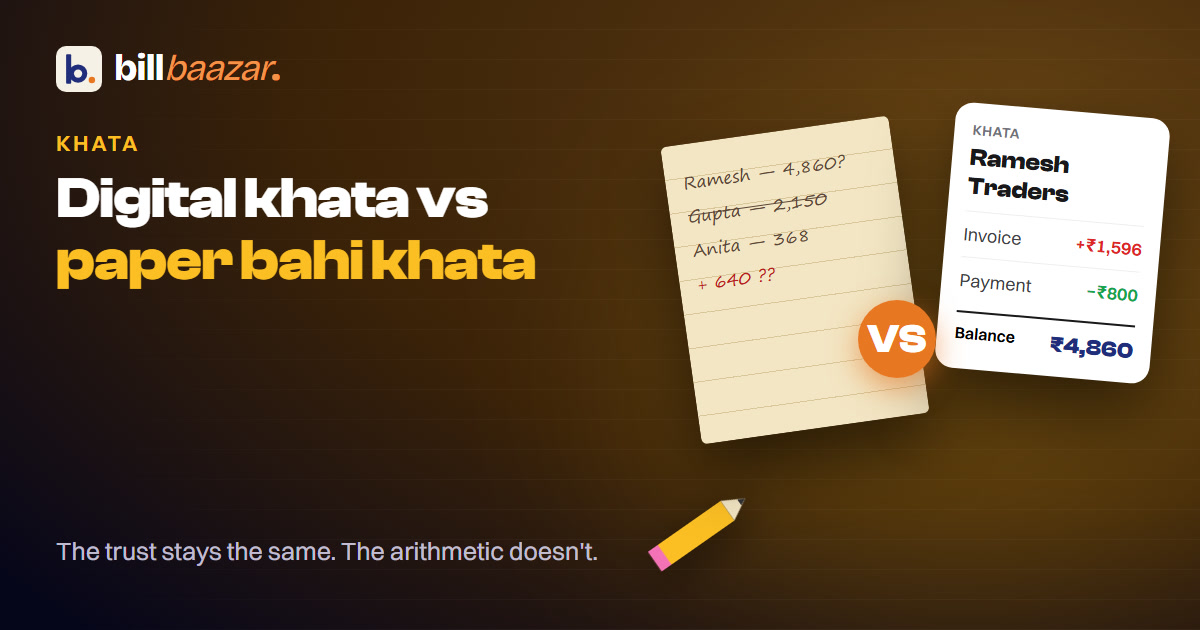
Every shopkeeper who has kept a bahi khata knows the real cost isn't the notebook — it's the argument. Here's what actually changes when that ledger becomes digital, and what doesn't.
What doesn't change
The relationship doesn't change. Khata is still credit extended on trust to a regular customer — nothing about digitising it makes a shopkeeper hand out credit to someone they wouldn't have trusted with a notebook entry. That decision stays exactly where it always was: with the shopkeeper.
What changes: where the entry comes from
A paper khata entry is a claim — a line written by hand, from memory, sometimes hours after the sale happened. A digital khata entry is a receipt — it's generated from an actual bill, with the date, items and rate already attached. That difference is the whole point. When a customer questions a number, "here is the bill it came from" ends the conversation in a way "I wrote it down" never does.
What changes: who can see the arithmetic
A monthly paper khata total is usually just a number at the bottom of a page. A digital statement can show the whole month as a grid — one row per day, the items bought, the rate used, and the running balance — sent directly to the customer's phone. Most disputes aren't about dishonesty; they're about a customer genuinely not remembering what they bought three weeks ago. Showing the breakdown, not just the total, is what actually shortens that conversation.
What changes: rate changes mid-month
This is the one thing paper genuinely can't do well. If a rate changes on the 15th, a paper khata just has one number for the whole month, with no way for the customer to check it. A digital khata can show the rate-wise split — so many units at the old rate, so many at the new — without anyone doing the sub-calculation by hand.
What doesn't get easier automatically
Digitising khata doesn't make a shopkeeper better at deciding who to extend credit to, and it doesn't collect the money by itself. It removes the specific friction of disputed arithmetic and lost notebooks — the rest of running a credit book is still a judgment call, same as always.
The actual test
If a regular customer asked to see exactly how this month's total was reached, could you show them in under a minute? That's the real difference between a paper khata and a digital one — not the device, the proof.
See how BillBaazar's digital khata works, or book a demo to see a real statement.
Try BillBaazar in your shop
Free for 15 days, no card needed. We'll move your customer list across for you.
Keep reading
Ready to close the notebook?
Set up your shop in ten minutes. Free for 15 days, no card, and we'll move your customer list across for you.