GST Billing for Small Shops, Explained Without the Jargon
Whether you need GST at all, what a valid tax invoice must contain, and the inclusive-versus-exclusive decision that confuses most shopkeepers.
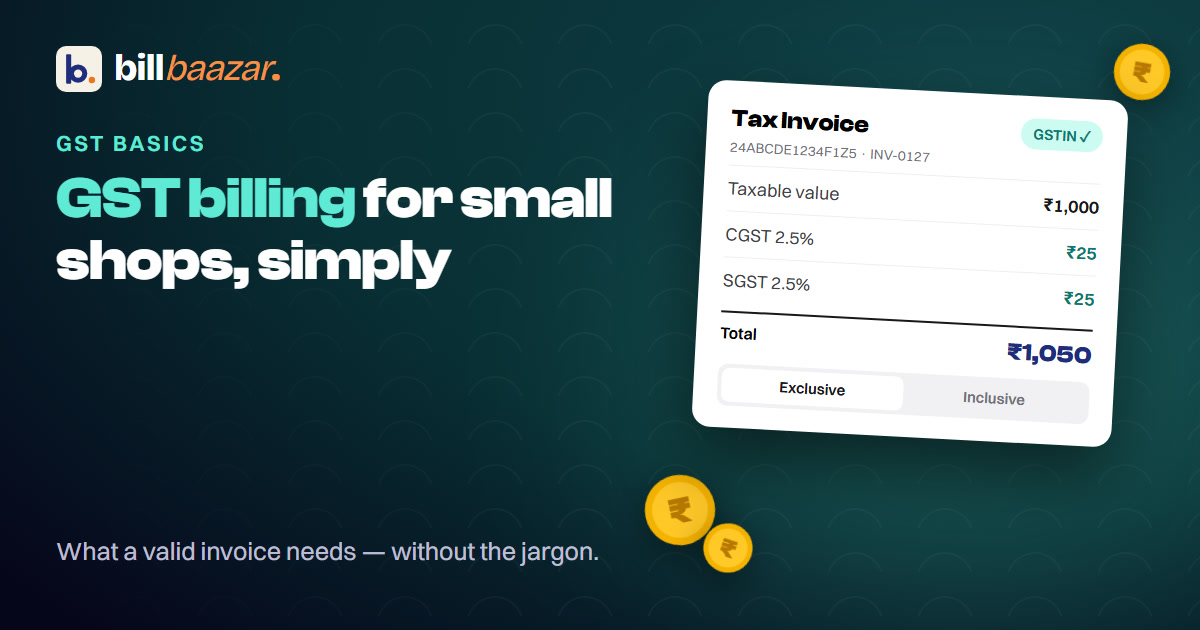
GST has a reputation for being complicated. For a small dairy shop it usually is not — but the explanations are. Here is the short version.
Do you even need GST?
If your annual turnover is below the registration threshold, you may not need to register at all. Plenty of neighbourhood dairies operate perfectly legally without GST. Ask your accountant about your specific numbers rather than guessing, and do not register just because it sounds more professional.
Also worth knowing: fresh milk is generally exempt, while processed dairy products such as ghee, paneer and flavoured milk are usually taxable. So two items on the same bill can be treated differently, which is exactly the sort of thing you want software to handle rather than remember.
What a proper tax invoice has to show
If you are registered, a bill is not just a bill. A valid tax invoice needs:
- Your shop name, address and GSTIN
- An invoice number and date
- The customer's name, and their GSTIN if they have one
- Each item with its HSN code, quantity and rate
- The taxable value
- SGST and CGST shown separately, not as one lump
- The total
That "separately" part trips people up. A bill showing "GST ₹12" is not a tax invoice. It has to show SGST ₹6 and CGST ₹6.
Inclusive or exclusive: the choice that confuses everyone
Exclusive means your listed rate is before tax, and GST is added on top. A ₹100 item at 5% becomes ₹105.
Inclusive means your listed rate already contains the tax. A ₹100 item at 5% is still ₹100 to the customer, of which ₹4.76 is the item and ₹4.24 is tax.
Which should you use? Counter shops selling to households almost always price inclusive — customers expect the shelf price to be the price they pay. Wholesale to other businesses is usually exclusive, because your buyer is claiming the tax back and wants to see it separated.
Many dairies need both. That is fine, as long as your billing can do both without you recalculating anything by hand.
The mistakes that actually cause trouble
- Skipping invoice numbers. They must be sequential and unbroken. A gap invites questions you will not enjoy.
- Wrong HSN codes. Set them once per product and stop thinking about it.
- Hand-calculating the tax split. Rounding errors across hundreds of bills add up to a mismatch nobody wants to reconcile at year end.
- No copy of the bill. If it only exists on the customer's thermal receipt, it does not exist.
Making it boring
The goal with GST is for it to be boring. Set the tax rate and HSN code on each product once, pick inclusive or exclusive per bill type, and let the arithmetic happen on its own. You should never be doing tax maths while somebody waits for their milk.
See how BillBaazar handles GST invoicing, or ask us on a call whether your shop needs it at all.
Try BillBaazar in your shop
Free for 15 days, no card needed. We'll move your customer list across for you.
Keep reading
Ready to close the notebook?
Set up your shop in ten minutes. Free for 15 days, no card, and we'll move your customer list across for you.